BlogPublished 27 October 2026
Is Carpooling Safe in the UAE? Insurance, Vetting and What to Check
A carpool in the UAE is safe when the car carries commercial passenger insurance and the operator holds a transport permit. It is not safe when neither is true, and the risk sits with the passenger rather than the driver. A private motor policy does not pay out when the person in the back seat paid for the seat.
That single sentence decides most of this question. Everything below is how to check it before you get in, and what the other safety questions really mean once the insurance one is settled.
The Insurance Question, First
Every car in the UAE must be insured. Not every policy covers what a carpool does.
A private motor policy covers the owner driving for personal reasons. The moment money changes hands for a seat, the trip becomes commercial use, and most private policies exclude it. If there is an accident, the insurer can decline the claim. The driver has a problem. So does anyone who was sitting in the car.
A commercial passenger policy covers paying passengers. It costs the operator more, which is part of why a licensed service charges more than a stranger splitting fuel.
So the question to ask is not whether the car is insured. It is whether the car is insured to carry you, specifically, as someone who paid.
How to Check Before You Book
Ask directly. A licensed operator will answer in one line, because the answer is yes and they would rather you asked.
Ask for the company name and the office address. A business with an address has something to lose. A phone number alone does not.
Ask what you will receive before pickup. A service that assigns drivers in advance can tell you the name, the photo and the plate number. A service that cannot is sending whoever answers, which means nobody checked that person before they collected you.
Ask what happens if you cancel. A clear rule, stated before you book, is a sign the rest of the arrangement is written down too.
If the answers come back vague on any of those, that is the answer.
What a Vetted Driver Means
The phrase gets used loosely, so here is what it should mean.
A valid UAE driving licence, checked rather than claimed. A background check completed before the driver carries anybody. Training on the route itself, with a senior driver, before a first passenger sits in the car.
That last one matters more on this corridor than people expect. A driver who does not know where the lane splits on the approach to Ghantoot, or which exit serves Khalifa City, makes decisions late. Late decisions are the ones that go wrong.
Our own drivers hold a UAE licence, pass a background check, and run the route with a senior driver before taking a first passenger. The name, photo and plate reach you before pickup, so you know which car is yours before it arrives.
Travelling With Strangers
This is the part most people actually mean when they ask whether carpooling is safe.
A shared seat means up to three other riders going the same way at the same time. They are not screened the way the driver is, and no operator should pretend otherwise. What a shared ride does give you is a driver who is accountable, a company that knows exactly who booked which seat, and a record of the journey.
That is a materially different situation from a lift arranged in a group chat, where nobody holds a record of anything.
If the idea still does not sit well, book the whole car. A private ride is AED 200 against AED 100 for a seat, and for two people travelling together it costs the same per head. Details are on the private car lift page.
Women Only Rides
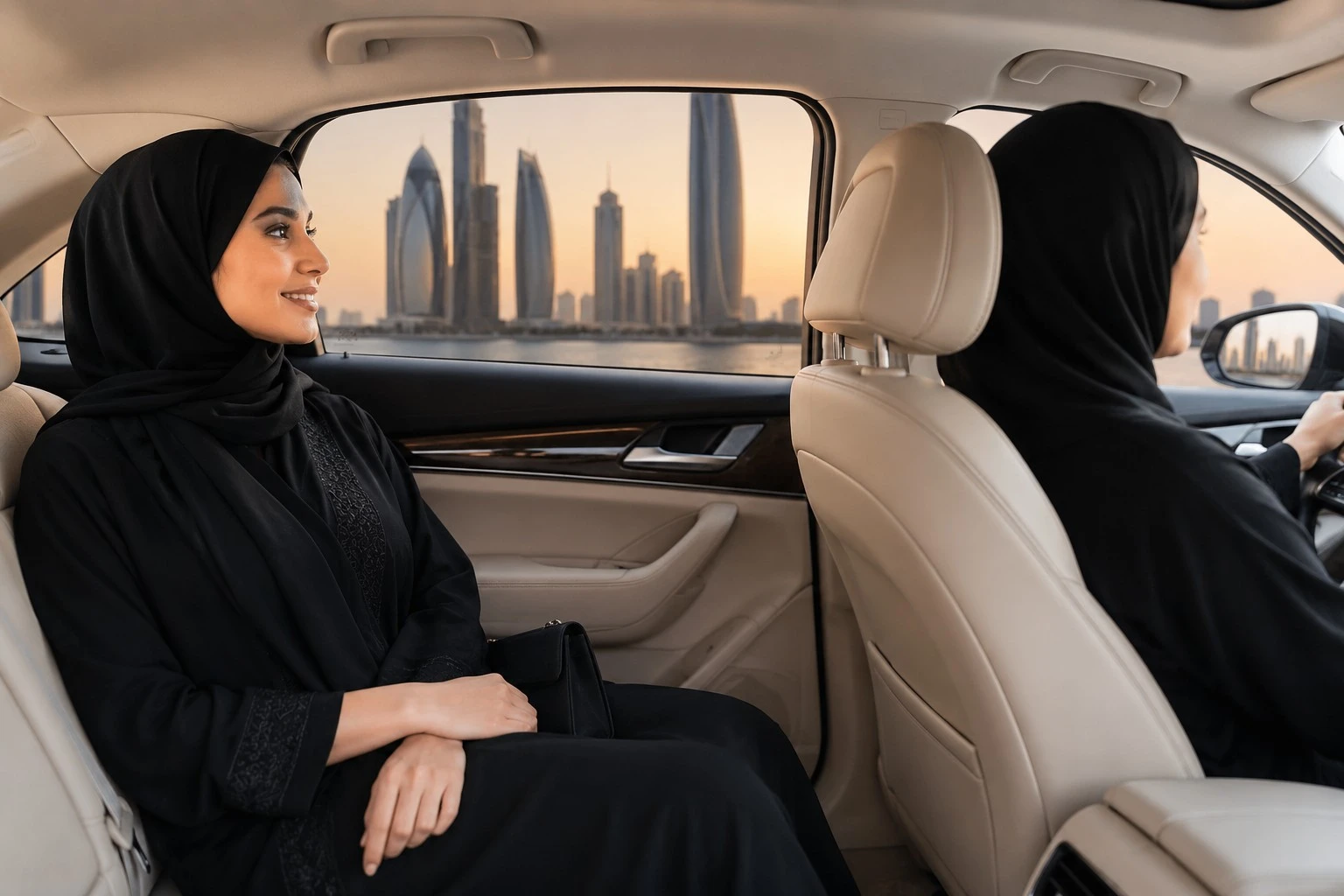
A ladies car lift is a women only ride. No male passengers share the car, and the driver is assigned rather than whoever happens to be nearest.
It can be booked as a shared seat or as a private car. The name, photo and plate still reach you before pickup, which for a lot of riders is the detail that matters most: you are not guessing at the kerb about which car to approach.
This is the one option a train cannot offer and a taxi cannot guarantee. If it is the reason you are reading this page, the ladies car lift page sets out how the booking works.
The Car Itself
Mechanical condition is a safety question, not a comfort one, on a 140 km run at motorway speed.
Three things to look for. Tyres with real tread, because the summer road surface is unforgiving. Air conditioning that works, because 90 minutes without it in July is a medical matter rather than an inconvenience. A car that matches the plate you were sent.
Every car in our fleet passes three checks before it goes out: mechanical condition, cooling and cleanliness. The active fleet holds 15 vehicles, 10 sedans, 3 SUVs and 2 luxury cars.
What to Do at the Kerb
Check the plate against the message before you open the door. This takes two seconds and it is the single most useful habit on this list.
Check the driver matches the photo.
Sit where you are comfortable. Nobody will mind.
Tell somebody your route and your expected arrival if you are travelling late or into an unfamiliar area. This is ordinary sense rather than a comment on any service.
Seatbelts and Children
Wear one, in every seat, including the back. UAE law requires it and the fine applies to the passenger.
If you are travelling with a child, say so when you book. A child seat is not something that can be produced at the kerb, and a car arriving without one means either an unsafe journey or a cancelled one.
Night Travel
The corridor is a lit motorway and the drive is no more dangerous after dark than before it. The things that change are fatigue and visibility.
A driver at the end of a long shift is the real risk on any night journey, which is an argument for a company that rotates drivers over one that does not. Ask how long the driver has been working if you are travelling very late. A straight answer is a good sign.
What Happens If Something Goes Wrong
With a licensed operator there is a company to call, a record of the booking, an insurer who covers passengers, and somebody whose name is on a permit.
With an informal lift there is a phone number that may stop working.
That difference costs about AED 40 a trip on this corridor. It is the clearest money on the whole page.
Is It Legal
Yes, when the operator is licensed and the car is insured for paying passengers. The detail of which authority regulates what, where the line falls between a favour and a fare, and what the penalties are for carrying passengers without a permit, is covered at length in our guide on whether car lift is legal in the UAE.
The short version for safety purposes is that legality and insurance are the same question wearing different clothes. An operator without a permit is also an operator whose cover will not hold.
Safety on the Longer Routes
Everything above applies on any corridor, but distance changes the weight of some of it.
On a 30 km run a tyre problem is an inconvenience. On the longer legs it is a stop on a hard shoulder in the heat. The same goes for air conditioning and for driver fatigue.
If you are booking one of the longer journeys, ask the mechanical questions rather than assuming. The fares on those routes are set by distance rather than averaged across the network, and each has its own page with the distance and journey time stated. The Dubai to Al Ain car lift page is a useful example of what that detail looks like.
Questions Worth Asking
Is the car insured to carry paying passengers?
Will I get the driver's name, photo and plate before pickup?
Is the driver assigned, or whoever is nearest?
What is your office address?
What happens if I cancel?
Five questions, about a minute. An operator who answers all five without hesitating is one you can book.
The Honest Summary
Carpooling in the UAE is safe when it is done by a licensed operator with commercial cover and drivers who were checked before they drove. It is a real risk when it is done informally, and the risk falls on the passenger, who is also the person least able to check.
The gap between those two situations is not large in money. It is very large in what happens on the worst day.
What a Permit Actually Means
A transport permit is the difference between a business and a person with a car.
It means an authority holds a record of the operator, that the vehicles are registered for commercial passenger use, and that there is somewhere to complain to which is not the driver himself. It is also what makes the insurance valid, which is why the two questions are really one question.
A permit does not guarantee a good journey. It guarantees somebody is answerable for a bad one.
How This Compares to a Ride Hailing App
An app gives you a tracked journey, a record and a complaints route. Those are real protections and worth having.
What an app does not give you on this corridor is the same driver twice, a fare fixed before you travel, or any say in who is assigned. Across a city that rarely matters. On a 140 km crossing you make every weekday it matters a great deal, because the variable is not the car. It is the person driving it at 06:30 and whether they have run this road before.
Both are safe in the ways that can be written into a policy. They differ in the ways that only show up on a route you repeat.
Reporting a Problem
Note the plate, the date and the time. That trio identifies a journey precisely, and without it a complaint becomes a conversation about what probably happened.
Raise it with the operator first, in writing. A company that cannot resolve something with a plate number and a timestamp in front of it is telling you something useful about itself.
For anything involving an accident, insurance or a licence, the police report is the document that counts and it should be made at the time rather than afterwards.
What Good Looks Like
You know the driver name before the day. You check a plate rather than guess. The car is cool when you get in. The fare is the one you were told. A number answers at 05:00.
None of that is dramatic. Safety on a repeated journey is mostly the absence of surprises, and an operator who removes surprises deliberately is doing the work on the days nothing happens too.
One Last Thing About Price
Cheap is a warning here.
A seat priced well under the market on this corridor is usually being subsidised by something, and on a 140 km run the thing being subsidised is almost always the insurance, the vehicle maintenance or the background check, because those are the only costs an operator can quietly stop paying without a passenger noticing on the day.
Fuel costs what it costs. Tolls cost what they cost. A driver has to be paid. When a fare sits far below the sum of those, ask which of them is missing, because one of them is.
The gap between a properly covered seat and an informal one is around forty dirhams on this route. That is the cheapest insurance you will ever buy.
The Short Checklist
Commercial passenger insurance. A permit. A named driver sent before the day. An office address. A cancellation rule in writing.
Five things, one message, about a minute of your time before a journey you may repeat two hundred times in a year.